

The revenue cycle should not be viewed as a billing-department workflow. Instead, it is the firmwide operating system that converts client commitments and legal work into profitable, collected revenue. For managing partners, COOs, and CFOs, its performance directly affects strategic capacity, partner confidence, client relationships, working capital, and the firm’s ability to invest.
Executive Summary
Many firms still manage conflicts, intake, engagement terms, pricing, matter setup, time capture, billing, e-billing, collections, and cash as separate, often siloed, functions. Each team may perform competently while the combined process produces avoidable delay, rework, write-downs, rejected invoices, strained client conversations, and unreliable forecasts. The leadership opportunity is to manage the lifecycle as one integrated commercial process with common data, explicit ownership, measurable controls, and consistent escalation.
The most important executive questions are practical: Where does revenue leak before an invoice is issued? Which policies are not translated into daily workflows? Where do partners and staff spend time correcting preventable errors? Which clients, practices, fee arrangements, and behaviors create recurring margin pressure? Which investments will shorten cycle time or improve realization, and who is accountable for achieving those outcomes?
A successful transformation aligns five elements: people, process, technology, data, and governance. It also connects pricing decisions to matter delivery and collections. The objective is not merely faster billing. It is a more predictable and disciplined commercial model that protects client trust while improving profitability and cash performance.
1. Treat the Revenue Lifecycle as a Single, Consolidated, Interoperable System
Revenue performance is determined long before a bill reaches the client. We hear, all the time, law firm managing partners and leadership teams pronouncing that their firm’s “billing and collections process is broken”. This is, in our experience, largely untrue.
Vague scope, unapproved timekeepers, inaccurate rate data, poor estimates, delayed time entry, misunderstood outside counsel guidelines, weak budgets, and unclear approval rights become downstream reductions, disputes, and collection delays – not to mention uncollectable fees. Correcting the final symptom does not remove the upstream cause.
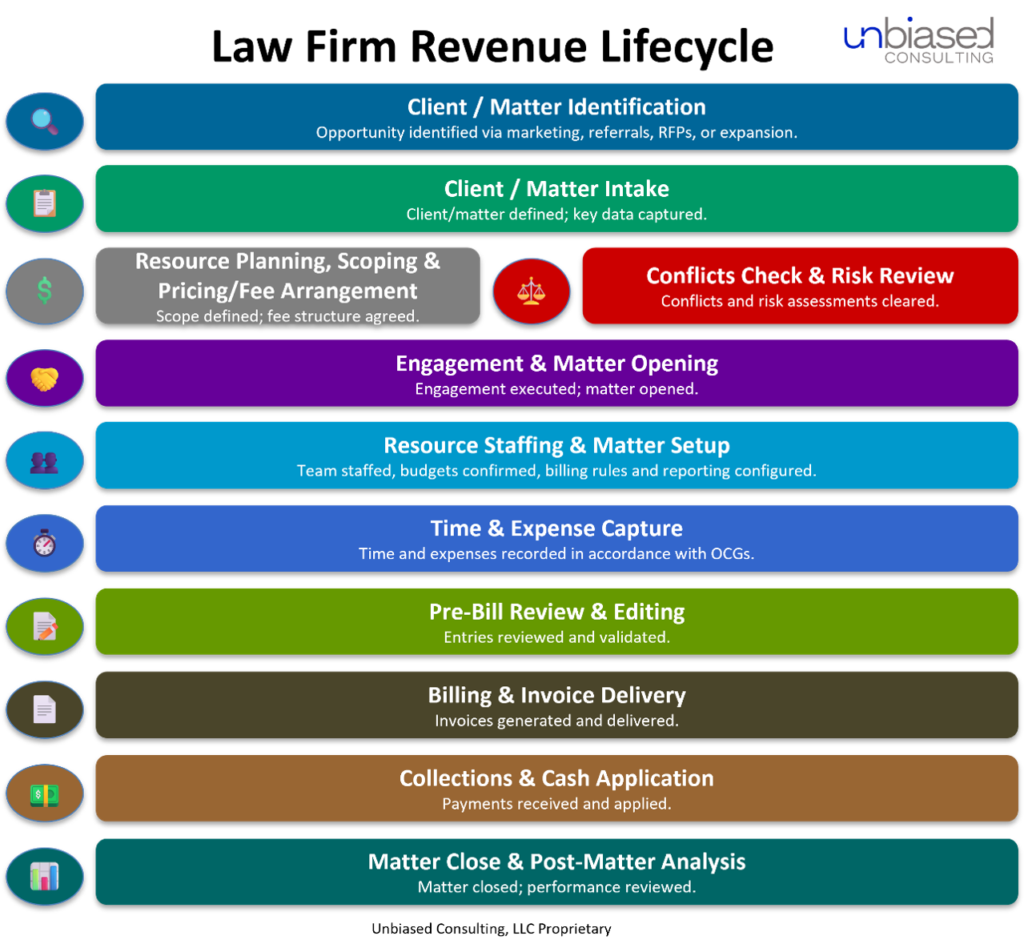
The law firm leadership team should view the lifecycle from client/matter opportunity identification through matter close.
Below is our graphical depiction of a law firm’s revenue lifecycle. Each activity set and function is critically important, and each is intertwined. One should no longer think of these as isolated activities, under inconsistent governance. Law firms must view the below as an integrated whole as opposed to isolated steps.
Executive accountability by role
The four roles below should sponsor a shared agenda rather than separate finance, operations, risk and partner initiatives. Revenue-cycle problems cross organizational boundaries; the governance model must do the same.
Managing Partner. Establish revenue-cycle performance as a firm priority, align practice leaders and partners, address behavior that undermines standards, and reinforce that commercial discipline supports—not compromises—client service.
Chief Operating Officer. Own the end-to-end operating model, eliminate unnecessary handoffs, clarify decision rights, coordinate functional leaders, and ensure that process changes are adopted in daily work.
Chief Risk Officer/OGC. Drive the client/matter risk mitigation model, balance risk vs. profits, protect the firm leveraging managed risk vs. “no risk” actions, help lawyers get to “Yes” in order to take on profitable work, where possible.
Chief Financial Officer. Define economic measures, quantify leakage and working-capital impact, strengthen forecasting, connect pricing to profitability, and provide transparent performance information to firm leadership.
2. Redesign the Operating Model Through Five Lenses
People: organize work around judgment and accountability
Attorneys should receive simple requirements, timely prompts and responsibilities, with clear visibility and transparency relative to their work. Finance, pricing, billing, IT, risk, and practice-management professionals need authority to resolve defined issues without unnecessary escalation. Routine routing, reconciliation, validation, and status follow-up should be standardized; negotiation, professional judgment, client communication, and complex exceptions should remain with accountable professionals.
Process: manage flow, not departmental activity
Map the current state from the client’s request through collected cash, including queues, wait time, approvals, handoffs, rework, and exceptions. Redesign around fewer touches, earlier validation, clear service levels, and visible escalation. Simplify the process before investing in additional tools.
Technology: requires a measurable business case
Evaluate capabilities based on issues and opportunity-based use cases. Review configuration, integration, workflow coverage, data quality, security, user adoption, vendor performance, and total cost. Better use of existing platforms may produce more value than replacement. AI can provide solutions that did not exist before. Every investment should have a named process owner, baseline performance and baselines, target outcome, implementation plan, structure, and post-launch benefit and ROI review.
Data: create one commercial record
Rates, terms, guidelines, staffing restrictions, budgets, invoice status, appeals, and collections information should move through the lifecycle without repeated work. Establish common definitions, ownership, quality standards, and access. Leaders should be able to trace a performance issue from matter opening through payment and distinguish an isolated exception from a systemic control failure.
Governance: turn improvement into operating discipline
Create a cross-functional revenue lifecycle owner and council with authority to approve standards, resolve recurring exceptions, prioritize investments, and monitor results. The council should include executive leadership, finance, pricing, billing, operations, technology, risk, and practice representatives. Its agenda should focus on decisions and corrective actions.
3. Protect Revenue Upstream and Price to Support Sustainable Margins
Move compliance upstream
Billing compliance protects revenues. Outside counsel guidelines and engagement terms commonly govern rates, staffing, codes, narratives, expenses, budgets, billing frequency, and submission formats.
When requirements are interpreted manually or checked only at invoice submission, the firm has already incurred avoidable correction cost and collection delay. Therefore:
- Centralize client terms, rates, budgets, staffing rules, and approved guideline interpretations.
- Assign accountable owners for updates, approvals, and exceptions.
- Validate timekeepers, rates, codes, narratives, expenses, and budgets before bills are generated.
- Separate genuine client disputes from preventable mechanical failures.
- Analyze reductions, rejections, appeals, and payment delays by client, practice, partner, and root cause.
Build a disciplined pricing architecture
Pricing should reflect scope, value, delivery risk, service expectations, cost to serve, and required margin. Historical hours are useful only after removing leakage, inefficient staffing, avoidable rework, and non-compliant activity. For each material engagement or portfolio:
- Segment the work into repeatable activities and professional judgment; define the unit of value for each.
- Establish a reliable cost baseline and model the intended staffing and delivery approach.
- Select the fee model—hourly, fixed or phased fee, subscription, portfolio, cap and collar, unit pricing, success component, or a governed hybrid.
- Document scope, volume assumptions, dependencies, exclusions, client responsibilities, service levels, and repricing triggers – as well as what the firm will not do and the change control approach
- Monitor predictability, quality, client outcomes, cost to service, realization, and margin—not hours alone.
Measure the goals and improvements
When re-engineering the revenue lifecycle, define desired outcomes, baseline at start and measure consistently. Sample desired outcomes and measures are listed below:
| Outcome | Measures for leadership review |
| Speed | Matter-opening time; time-entry lag; bill cycle time; rejection-resolution time; days to cash |
| Quality and compliance | First-pass acceptance; compliant entries; reduction and appeal rates; recurring exceptions |
| Economics | Worked, billed, and collected realization; margin by matter and fee type; leakage by root cause |
| Client value | Budget predictability; service-level performance; feedback; matter outcomes |
| Adoption and capacity | Attorney touches; staff rework; workflow adoption; manual workarounds; training effectiveness |
4. Execute a Focused Transformation Roadmap (where UBC can help you!)
Phase 1 — Diagnose and align
Define the business case and executive outcomes. Map the lifecycle, interview partners, legal assistants, functional leaders and impacted business professionals, assess controls and data, inventory existing capabilities, identify and quantify friction points, and identify the clients, practices, and workflows producing the greatest leakage or burden. Establish baseline measures before selecting solutions.
Phase 2 — Design and prioritize
Design the future-state operating model (policy, people and process), decision rights, service levels, controls, data requirements, and change plan. Rank opportunities by economic value, client impact, risk, readiness, effort, and dependency. Balance near-term improvements—such as faster time entry or cleaner matter setup—with foundational changes in data, ownership, and governance. Then design and define the automation/technology to support the above.
Phase 3 — Pilot and prove
Choose a meaningful but manageable legal practice, client portfolio, or workflow. Test standards with the attorneys and professionals who will use them, monitor exceptions, gather client and team feedback, and validate the financial impact. A pilot should answer whether the operating model works, whether behaviors changed, and whether benefits justify scaling.
Phase 4 — Scale and govern
Roll out in waves, retire workarounds, embed training and communications, publish scorecards, and maintain the revenue council. Focus on adoption. Revisit standards as client requirements, pricing practices, and business conditions change. Assign owners and require periodic confirmation that expected gains were realized.
Establish a leadership agenda to support adoption and success
- Select two or three outcomes, such as improved collected realization, shorter bill cycle time, or reduced days to cash.
- Name one executive sponsor and one accountable owner for each major workstream.
- Publish common definitions and a small scorecard with targets, thresholds, and corrective-action requirements.
- Address partner behavior and policy exceptions directly; process redesign cannot succeed if leadership tolerates inconsistent compliance.
- Sequence investment decisions after process, ownership, data, and control requirements are clear.
Conclusion: Choose a Path, Not a Product
Revenue-cycle transformation is a firmwide business strategy, not a software implementation or a billing-department project. The strongest approach begins with an independent view and ownership of the whole lifecycle, a fact-based understanding of friction points and leakage, and a structured plan that balances immediate returns with the long term. For managing partners, COOs, GC’s and CFOs, the central question is straightforward:
Where is the firm working harder than it should to earn and collect the revenue it has already created?